Attached is a research abstract which is geared more for licensing researchers and regulatory scientists who are responsible for analyzing regulatory compliance data and doing studies related to overall compliance with rules and regulations and program quality. This abstract provides an overview of descriptive statistics, correlational, and ANOVA statistics that researchers and scientists may find interesting in their own studies related to the special considerations to be undertaken when doing regulatory compliance studies.
There are several tables and graphs that clearly depict the ceiling effect and the diminishing returns effect which is characteristic of regulatory compliance data when compared to program quality data. But there are examples of just the general descriptive nature of the data which might be helpful to researchers and scientists in thinking about how best to design their studies. I am continuing a deep dive into the regulatory compliance data sets to determine what other parameters and trends exist in the respective databases in the international early childhood program quality improvement and indicator model maintained at the Research Institute for Key Indicators Data Laboratory/Penn State University. I will share results as I have them in subsequent posts on this RIKINotes Blog.
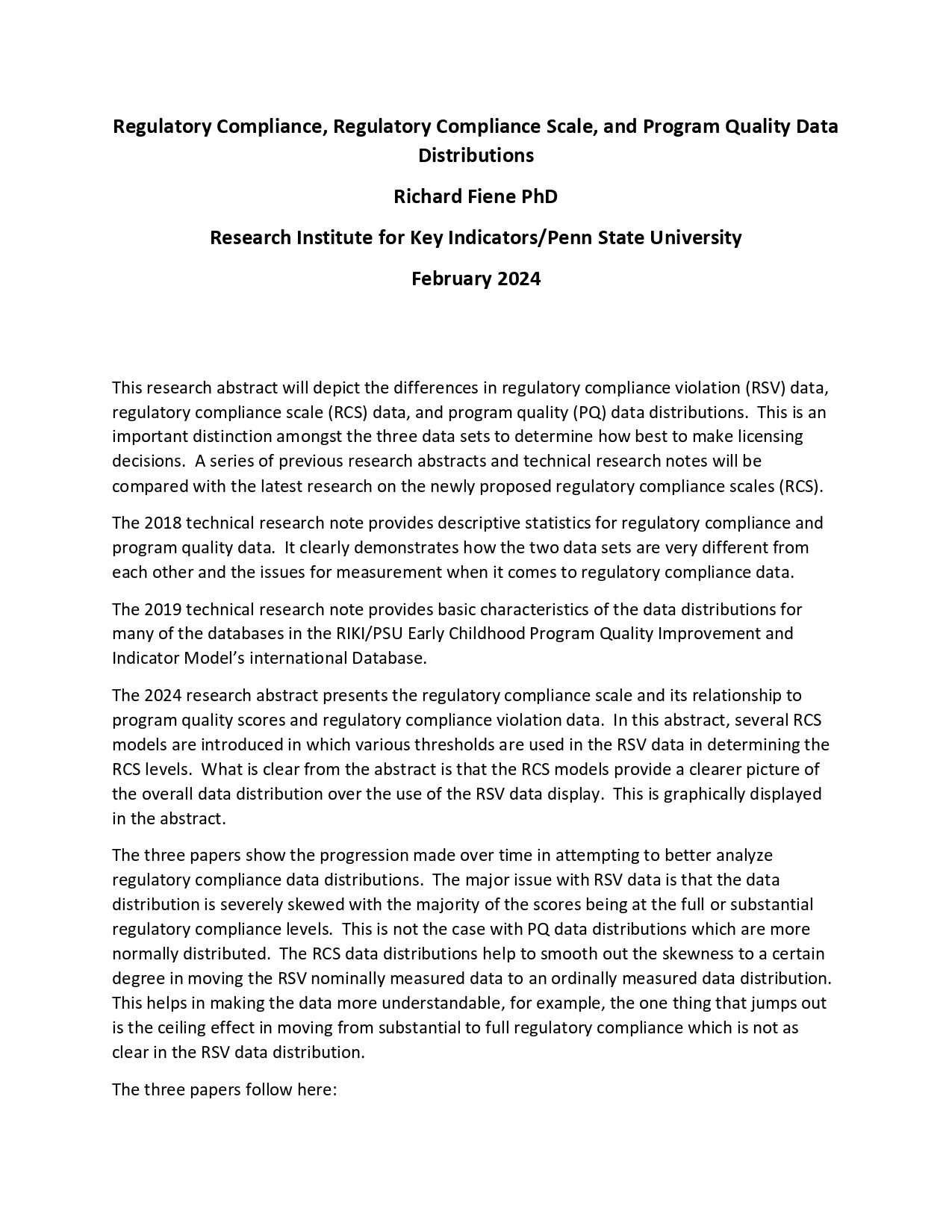
As one will see, the use of a regulatory compliance scaling approach has several advantages when compared to the more direct approach of a regulatory compliance violation data distribution. Both from a visual display in which differences are more clearly articulated in various buckets of compliance, such as, fully compliant, substantially compliant, medium compliant, and low compliant; and from an analytical frame where the scaling appears to enhance certain statistical analyses over a straight frequency count of violations. For example, it appears to level out some of the skewness in the overall regulatory compliance data distribution.
The other advantage of using a regulatory compliance scaling approach is that it is a bit more intuitive and seems to fit with the regulatory compliance research literature when it comes to being in full, substantial or mediocre compliance. It just makes sense when licensors think about it and talk about it, this is the terminology that is used in discussions. The other advantage is in the scale itself. It matches with other Likert scales that are presently used in the field, such as the Environmental Rating Scales with a 1-7 scale. The regulatory compliance violation data where a zero (0) is considered a perfect score is just counter-intuitive. You get around this by subtracting the number of violations from a perfect score of 100 but that’s an extra step to take in your measurement scheme. A Likert scale from 1-7 with 7 being equivalent to full 100% regulatory compliance and 1 being equivalent to low regulatory compliance just works better from an analytical framework.
I have struggled with the lack of variance and the severe skewness in regulatory compliance data over the years. Using a regulatory compliance scaling approach as outlined in this abstract may help us to overcome some of these shortcomings. Weighting of rules and regulations has been proposed and used by a number of state licensing agencies and this has worked well at the individual rule differentiation level but it has not really been employed at the aggregate rule level. A regulatory compliance scaling approach may help to enhance the weighting methodology as one moves from an individual rule to an aggregate rule format. I encourage licensing researchers and regulatory scientists to entertain exploring the use of this scaling technique as they more forward in their research studies on regulatory compliance.
 RIKI - Research Institute for Key Indicators Data Laboratory
Leave a comment